iPhone 18 Pro Max Galaxy S26 Ultra Pixel 11 Pro XL Display Comparison: Which Mind-Blowing Flagship Screen Wins in 2026?
If you’re trying to make sense of the iPhone 18 Pro Max Galaxy S26 Ultra Pixel 11 Pro XL display comparison, you’ve picked an interesting year to shop. For the…
If you’re trying to make sense of the iPhone 18 Pro Max Galaxy S26 Ultra Pixel 11 Pro XL display comparison, you’ve picked an interesting year to shop. For the first time in a while, Apple, Samsung, and Google all have genuinely new flagship displays on the market at the same time and on paper, they look closer than ever. But “close on paper” and “identical in daily use” are two very different things, and that’s exactly where this iPhone 18 Pro Max Galaxy S26 Ultra Pixel 11 Pro XL display comparison earns its keep.
This guide breaks down resolution, brightness, refresh rate, panel technology, and the unique screen features each company is betting on synthesized from official specs, manufacturer data, and real-world reporting so you’re not just staring at a spec sheet wondering what any of it actually means.
Quick-Look Display Specs Table
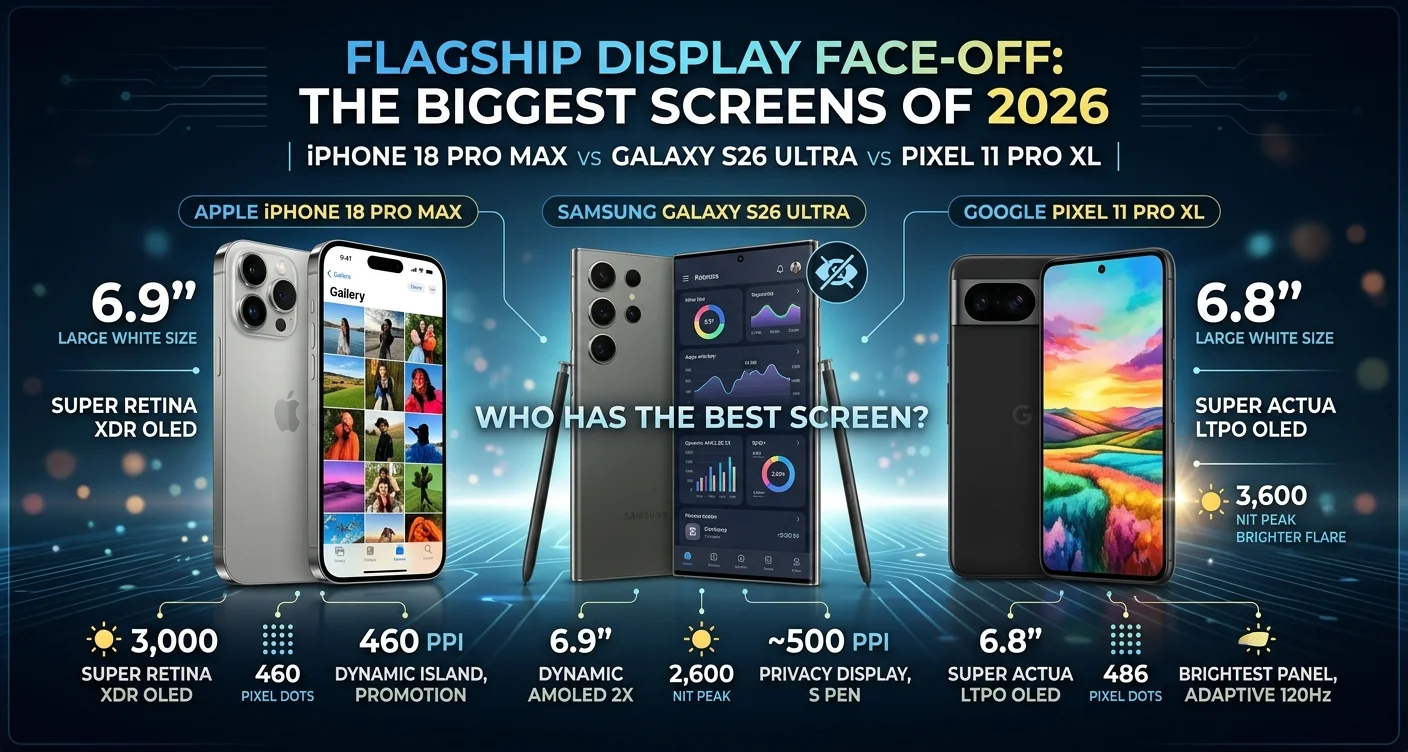
| Specification | Samsung Galaxy S26 Ultra | Google Pixel 11 Pro XL | Apple iPhone 18 Pro Max |
| Display size | 6.9″ | 6.8″ | 6.9″ |
| Panel type | Dynamic AMOLED 2X | LTPO OLED (Super Actua) | Super Retina XDR OLED |
| Resolution | QHD+ (~3120 × 1440) | 1344 × 2992 | 2868 × 1320 |
| Pixel density | ~500 PPI | 486 PPI | 460 PPI |
| Refresh rate | 1–120Hz adaptive | 1–120Hz adaptive | Up to 120Hz ProMotion |
| Peak brightness | 2,600 nits | 3,600 nits | 3,000 nits (outdoor) |
| Protection glass | Reinforced glass (unspecified generation) | Corning Gorilla Glass Victus 2 | Ceramic Shield 2 |
| Standout feature | Built-in Privacy Display, S Pen | Brightest panel of the three | Dynamic Island, Always-On display |
With the numbers laid out, let’s dig into what they actually mean for the person holding the phone.
Display Size and Screen Real Estate
Two of these three phones are essentially tied on size, and one is a hair smaller.
iPhone 18 Pro Max: 6.9 Inches
Apple’s largest iPhone display sits at 6.9 inches, matching its predecessor almost exactly. The screen keeps a flat panel design rather than curving at the edges, which helps reduce accidental touches and keeps color accuracy consistent right to the border.
Galaxy S26 Ultra: 6.9 Inches
Samsung matches Apple inch-for-inch at 6.9 inches. Combined with the S Pen and a slightly more compact chassis than you’d expect for the screen size, Samsung continues to make the most of its bezel-to-body ratio.
Pixel 11 Pro XL: 6.8 Inches
Google’s flagship comes in marginally smaller at 6.8 inches. It’s a difference you’d be hard-pressed to notice in daily use, but it does contribute to the Pixel being the lightest of the three phones at 226 grams, versus 249 grams for the iPhone 18 Pro Max.
Resolution and Sharpness: Pixel Density Breakdown
This is where the iPhone 18 Pro Max Galaxy S26 Ultra Pixel 11 Pro XL display comparison actually starts showing meaningful separation, even if the practical difference is smaller than the numbers suggest.
Samsung Takes the Resolution Crown
The Galaxy S26 Ultra ships with a QHD+ panel, translating to a pixel density of roughly 500 PPI the sharpest of the three at native resolution. Samsung typically defaults the phone to a lower resolution out of the box to save battery, with the full QHD+ mode available as an option in settings.
Pixel 11 Pro XL Isn’t Far Behind
At 1344 × 2992 pixels and 486 PPI, the Pixel 11 Pro XL trails Samsung by a small margin. In practical terms, both phones render text and fine detail with essentially indistinguishable sharpness to the naked eye at normal viewing distances.
iPhone 18 Pro Max Prioritizes a Different Balance
Apple’s 2868 × 1320 resolution works out to about 460 PPI technically the “lowest” number of the three, but this has been Apple’s approach for years, favoring power efficiency and color calibration over chasing raw pixel count. In side-by-side use, most people cannot reliably tell the three panels apart purely on sharpness.
Takeaway: if pixel density is your deciding factor, Samsung wins narrowly but this is one spec where the difference matters far less than marketing numbers imply.
Refresh Rate and Motion Handling
All three phones now support adaptive refresh rates that scale between 1Hz and 120Hz depending on what’s on screen, which is a genuine convergence point in this comparison.
- Galaxy S26 Ultra: 1–120Hz adaptive, tuned aggressively for gaming and scrolling smoothness.
- Pixel 11 Pro XL: 1–120Hz adaptive, paired with Google’s software-level motion smoothing for video playback.
- iPhone 18 Pro Max: Up to 120Hz via ProMotion, with Apple’s LTPO implementation allowing the display to drop all the way down to support the Always-On display without excess battery drain.
Functionally, scrolling, gaming, and video feel equally fluid across all three devices the differences here show up more in battery efficiency than in visible smoothness.
Peak Brightness and Outdoor Visibility
This is arguably the most important and most overlooked category in any real-world iPhone 18 Pro Max Galaxy S26 Ultra Pixel 11 Pro XL display comparison, because brightness determines whether you can actually read your screen at noon in direct sunlight.
Google Pixel 11 Pro XL: The Brightness Leader
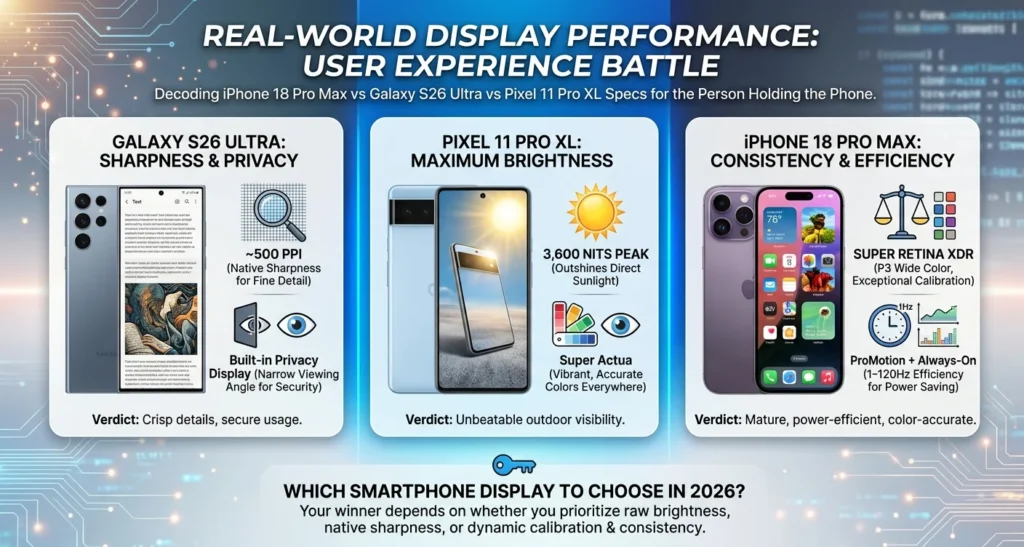
At up to 3,600 nits peak brightness, the Pixel 11 Pro XL posts the highest manufacturer-published brightness figure of the three. Based on official specs alone, it should be the easiest of the three screens to read outdoors in harsh sunlight.
Apple iPhone 18 Pro Max: Strong, Consistent Outdoor Performance
Apple rates the iPhone 18 Pro Max at up to 3,000 nits for outdoor brightness, with a notably low 1-nit minimum brightness for comfortable nighttime viewing a wider usable brightness range than raw peak numbers alone suggest.
Samsung Galaxy S26 Ultra: The Trade-off for Privacy
At 2,600 nits peak, the Galaxy S26 Ultra posts the lowest number of the three on paper. However, Samsung offsets this with its built-in Privacy Display, which narrows the viewing angle to shield your screen from people beside you a genuinely unique feature not found on the other two phones, even if it comes with a brightness trade-off.
Takeaway: for pure sunlight readability, Google’s numbers put the Pixel 11 Pro XL ahead on paper, with Apple close behind and Samsung trading some brightness for privacy functionality.
Display Technology and Panel Type
- Samsung’s Dynamic AMOLED 2X has long been one of the industry’s most color-accurate and power-efficient OLED implementations, and the S26 Ultra continues that tradition while adding the Privacy Display layer.
- Google’s Super Actua LTPO OLED panel is Google’s branded evolution of its display stack, built around HDR performance and now protected by Corning’s Gorilla Glass Victus 2 for improved drop and scratch resistance.
- Apple’s Super Retina XDR OLED panel pairs P3 wide color coverage with Apple’s Ceramic Shield 2 protective layer, continuing the company’s flat-panel, color-managed approach rather than chasing curved edges or ultra-high resolution.
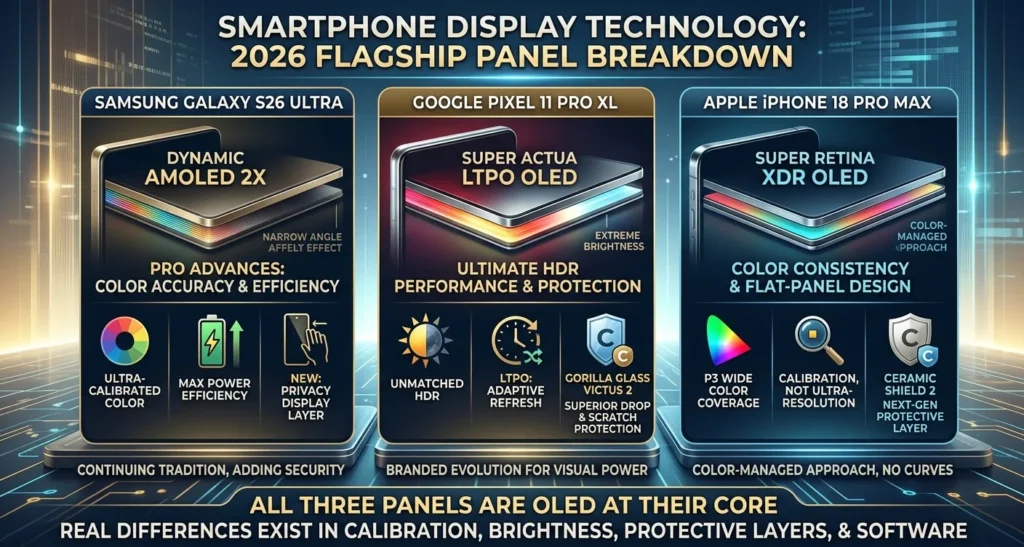
All three are OLED at their core, which means the meaningful differences now live in calibration, brightness handling, and the software layered on top not in the fundamental panel technology.
Unique Display Features Worth Knowing
Samsung’s Privacy Display and S Pen Integration
No other phone in this comparison offers a hardware-level privacy screen. Combined with S Pen support for note-taking directly on the display, Samsung is clearly targeting productivity-focused buyers who value both security and stylus input.
Apple’s Dynamic Island and Always-On Display
The iPhone 18 Pro Max’s Dynamic Island now roughly 35% smaller than previous generations continues to double as a live activity hub, while the Always-On display leans on the panel’s LTPO efficiency to show glanceable information without materially affecting battery life.
Google’s Software-Driven Display Experience
While the Pixel 11 Pro XL doesn’t introduce a new physical display gimmick, Google leans on Gemini-powered features and the HiLight notification light on the camera bar to compensate meaning the “smartest” screen experience may come down to software rather than hardware.
Which Display Should You Actually Choose?
- Pick the Galaxy S26 Ultra if: you want the sharpest resolution, S Pen functionality, and a display that protects your privacy in public.
- Pick the Pixel 11 Pro XL if: outdoor visibility and raw brightness are your top priority, and you want the lightest phone of the three.
- Pick the iPhone 18 Pro Max if: you value consistent color accuracy, a mature Always-On display, and the tightest hardware-software integration.
Final Verdict on the Display Comparison
There’s no single “winner” in this iPhone 18 Pro Max Galaxy S26 Ultra Pixel 11 Pro XL display comparison each company optimized for a different priority. Samsung chased resolution and privacy, Google chased brightness, and Apple chased color consistency and efficiency. For most buyers, the deciding factor won’t be the display at all, but which ecosystem, camera system, or AI features matter more to how you actually use your phone.
Frequently Asked Questions (FAQs)
Which phone has the best display: iPhone 18 Pro Max, Galaxy S26 Ultra, or Pixel 11 Pro XL?
There’s no outright winner the Galaxy S26 Ultra has the sharpest resolution, the Pixel 11 Pro XL has the highest peak brightness, and the iPhone 18 Pro Max offers the most consistent color accuracy and efficient Always-On display.
Which phone has the brightest screen in 2026?
Based on manufacturer specs, the Google Pixel 11 Pro XL leads with up to 3,600 nits peak brightness, ahead of the iPhone 18 Pro Max’s 3,000 nits and the Galaxy S26 Ultra’s 2,600 nits.
Does the Galaxy S26 Ultra have a higher resolution than the iPhone 18 Pro Max?
Yes. The Galaxy S26 Ultra’s QHD+ display (roughly 500 PPI) is sharper on paper than the iPhone 18 Pro Max’s 460 PPI Super Retina XDR panel, though the difference is barely noticeable in everyday use.
What is Samsung’s Privacy Display feature?
It’s a hardware-level display feature on the Galaxy S26 Ultra that narrows the viewing angle so people sitting beside you can’t easily see your screen, while your own view remains completely normal.
Do all three phones support 120Hz refresh rates?
Yes. The iPhone 18 Pro Max, Galaxy S26 Ultra, and Pixel 11 Pro XL all support adaptive refresh rates up to 120Hz, scaling down to as low as 1Hz to save battery when appropriate.
Which display is best for outdoor use in direct sunlight?
The Pixel 11 Pro XL’s 3,600-nit peak brightness gives it a theoretical edge outdoors, though the iPhone 18 Pro Max’s 3,000-nit outdoor rating keeps it very close in practice.
Does the iPhone 18 Pro Max have an Always-On display?
Yes, and it continues to use Apple’s LTPO display technology to show glanceable information at very low refresh rates without significantly draining the battery.
Which phone’s display is best protected against drops and scratches?
The Pixel 11 Pro XL uses Corning Gorilla Glass Victus 2, and the iPhone 18 Pro Max uses Apple’s Ceramic Shield 2. Samsung’s exact glass generation for the S26 Ultra isn’t officially detailed in the same way, though it maintains an IP68 rating like the other two.
Is a bigger display always better?
Not necessarily. The Galaxy S26 Ultra and iPhone 18 Pro Max are both 6.9 inches, while the Pixel 11 Pro XL’s slightly smaller 6.8-inch screen makes it the lightest of the three phones a meaningful trade-off for people who prioritize comfortable one-handed use.
Which phone supports stylus input on its display?
Only the Galaxy S26 Ultra offers built-in S Pen support, making it the clear choice for anyone who wants to write, sketch, or annotate directly on the screen.
Does display resolution affect battery life?
Yes, indirectly. Higher resolutions like the Galaxy S26 Ultra’s QHD+ panel can demand more power at native resolution, which is why Samsung often defaults to a lower resolution setting out of the box to preserve battery life.
Which display technology is used across all three phones?
All three use OLED-based display technology Samsung’s Dynamic AMOLED 2X, Google’s Super Actua LTPO OLED, and Apple’s Super Retina XDR OLED meaning the real differences come down to calibration, brightness tuning, and added features rather than the underlying panel type.