AI Character Consistency Without LoRA: The Simplest Method That Actually Works (2026)
AI character consistency without LoRA is no longer a workaround it’s become the standard way most creators keep their characters looking the same across every image, scene, and video frame….
AI character consistency without LoRA is no longer a workaround it’s become the standard way most creators keep their characters looking the same across every image, scene, and video frame. For years, the only reliable fix for character drift was training a LoRA, but LoRA training is slow, model-specific, and breaks the moment a new checkpoint drops. Today, a new generation of reference-based tools and zero-shot models makes Artificial Intelligence character consistency without LoRA not just possible, but often faster and more flexible than the old training-based approach.
This guide walks through the best AI tools for creating consistent characters, how they actually achieve AI character consistency without LoRA, and a practical workflow you can copy today no training, no datasets, no GPU rental required.
What “AI Character Consistency” Actually Means
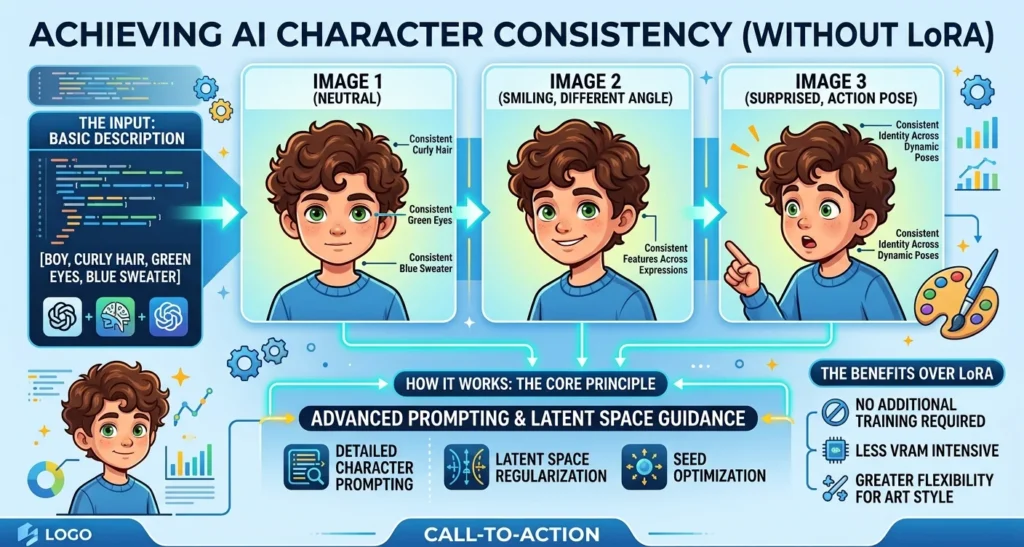
Character consistency is the ability to generate the same character same face, same proportions, same wardrobe, same distinguishing features across multiple images, poses, and even video frames. Diffusion models don’t have memory by default. Every generation starts from random noise, so unless something anchors the identity, the model reinterprets your description from scratch each time.
That “something” used to almost always be a LoRA. Today, it doesn’t have to be. Achieving AI character consistency without LoRA now comes down to giving the model a strong external reference a face, a character sheet, or a named identity instead of baking that identity into the model’s weights.
Why LoRA Isn’t Always the Right Answer
LoRA (Low-Rank Adaptation) fine-tunes a small subset of a model’s parameters so it can reliably reproduce a specific character. It works well, but it comes with real friction that makes AI character consistency without LoRA an attractive alternative for most creators.
The Hidden Cost of Training a Character LoRA
Training a usable LoRA typically means collecting anywhere from a handful to several dozen reference images, cleaning and captioning that dataset, running a training job (which usually needs GPU access), and then testing multiple checkpoints to find the one that generalizes well without overfitting. Even after all that, the LoRA is tied to the base model it was trained on. When a new model releases which happens constantly in this space the LoRA usually needs to be retrained from scratch. This is exactly the overhead that AI character consistency without LoRA is designed to eliminate.
When LoRA Still Has Value
To be fair, LoRA hasn’t disappeared. For characters that need to hold up across hundreds of generations, extreme pose variation, or highly stylized non-human designs, a trained LoRA can still outperform reference-based methods. But for the vast majority of use cases social content, comics, marketing visuals, short-form video the gap between LoRA-based and reference-based consistency has narrowed enough that most creators no longer see training as worth the overhead. This is exactly why the search for AI character consistency without LoRA has grown so quickly.
The Best AI Tools for Creating Consistent Characters Without LoRA
Here’s where the real value is: a handful of tools and techniques now solve character consistency at generation time, rather than through model training, making AI character consistency without LoRA achievable for anyone.
1. Reference-Based Character Systems
Several platforms now let you upload a handful of photos, name the character once, and reuse that identity by simply tagging it in future prompts similar to mentioning a person in a document. This approach removes the training step entirely while still giving each generation a strong visual anchor. It’s arguably the fastest route to AI character consistency without LoRA, since setup takes minutes rather than hours.
2. Multi-Angle Character Sheets
Instead of a single portrait, professional workflows now build a full character sheet front view, three-quarter view, profile, back view, and close-up expressions generated once and reused as a reference for every future shot. The sheet becomes the “source of truth” that gets attached to every new prompt, so the model always has a real image to match against rather than a text description alone. This method has become one of the most reliable ways to get AI character consistency without LoRA, especially for storyboards, comics, and short films, because it holds up across dramatically different poses and lighting conditions.
3. Zero-Shot Identity Models
The biggest recent shift toward AI character consistency without LoRA comes from newer “zero-shot” image models that can preserve a face, hairstyle, and build from just one or two reference images no fine-tuning step at all. These models read the reference image directly at generation time and blend it with your text prompt, producing results that rival trained LoRAs in seconds rather than hours. For creators who need speed and flexibility across many characters at once, this is currently the strongest alternative to LoRA training.
4. Identity Locking Without Face-Swap Tools
A common misconception is that skipping LoRA means relying on face-swapping tools instead. In practice, the more reliable path to AI character consistency without LoRA avoids face-swap plugins altogether and instead locks identity earlier in the pipeline — through the reference image or character sheet itself — so the face never needs to be swapped in after the fact. This produces more natural lighting, shadows, and skin texture than a post-hoc face swap typically can.
A Practical Workflow for AI Character Consistency Without LoRA
If you want a repeatable process rather than trial and error, follow this sequence:
- Generate a strong base portrait. Spend extra time getting the face, styling, and lighting right in your very first image this becomes your anchor.
- Build a mini character sheet. Generate 3–5 additional angles (three-quarter, profile, full body) using the base portrait as a reference.
- Store the sheet, not just the description. Keep the actual image files accessible in your workflow rather than relying on a written description of the character.
- Attach the reference to every new prompt. Whether you’re using a reference-conditioning feature or a named-character tag, make sure the visual anchor is present in every generation, not just the first one.
- Vary the scene, not the anchor. Change lighting, background, and pose in your text prompt while keeping the reference constant this is where most of the “drift” people complain about actually comes from.
- Batch-test before committing. Generate several variations per scene and pick the best match rather than accepting the first result.
This is essentially the same discipline that made LoRA training effective just applied without the training step, which is the core idea behind AI character consistency without LoRA.
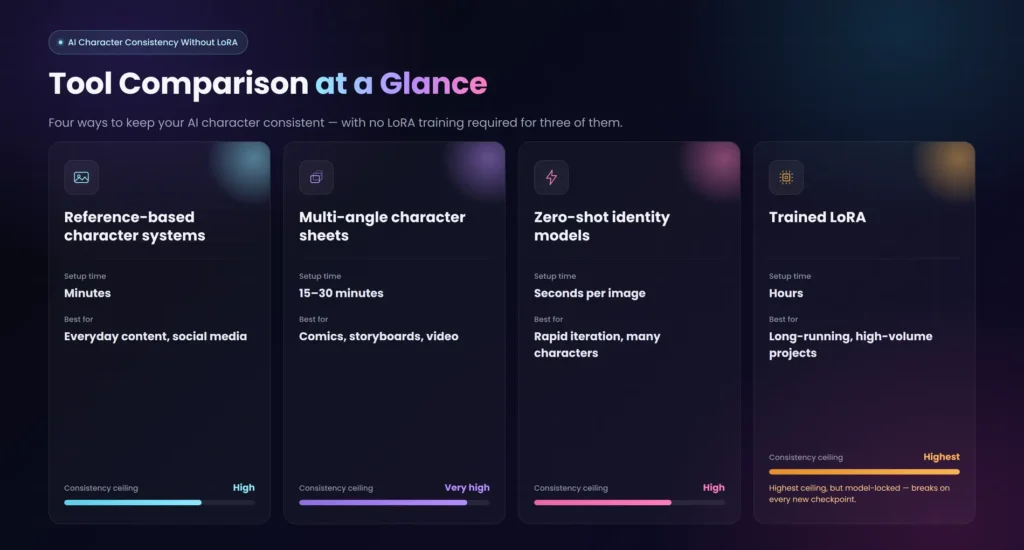
Tool Comparison at a Glance
| Method | Setup Time | Best For | Consistency Ceiling |
| Reference-based character systems | Minutes | Everyday content, social media | High |
| Multi-angle character sheets | 15–30 minutes | Comics, storyboards, video | Very high |
| Zero-shot identity models | Seconds per image | Rapid iteration, many characters | High |
| Trained LoRA | Hours | Long-running, high-volume projects | Highest, but model-locked |
Common Mistakes That Break Character Consistency
Even with the right tools, a few habits quietly undo AI character consistency without LoRA:
- Rewriting the description instead of reusing the reference. Text descriptions drift; images don’t.
- Skipping the character sheet step. A single reference photo struggles once you need side profiles or full-body shots.
- Changing too many variables at once. Shifting lighting, pose, and outfit in the same generation makes it harder to judge whether identity actually held.
- Ignoring model-specific reference formats. Not every model reads reference images the same way check documentation before assuming a workflow will transfer.
Frequently Asked Questions
Is it really possible to get AI character consistency without LoRA?
Yes. Modern reference-conditioning tools and zero-shot identity models can match or come close to LoRA-level consistency for most everyday use cases, without any training step. AI character consistency without LoRA has become the default workflow for most creators in 2026.
What’s the fastest way to achieve AI character consistency without LoRA?
Uploading a clear reference image (or a small character sheet) and reusing it across every prompt is the fastest method no dataset assembly or GPU training required.
Do I still need a LoRA for video projects?
Not necessarily. Many creators now lock a character sheet into their workflow and reuse it across every shot of a video project, achieving AI character consistency without LoRA even across dozens of scenes.
Why does my AI character’s face keep changing between images?
This usually happens because the model is relying only on your text description rather than a persistent visual reference. Attaching an actual reference image to each generation solves most drift issues, even without LoRA.
Are face-swap tools a good substitute for LoRA?
They can help in a pinch, but face-swapping often introduces mismatched lighting and skin tone. Reference-based generation from the start typically produces more natural results than swapping a face in afterward.
Which is better for beginners LoRA or reference-based methods?
Reference-based methods are far more beginner-friendly. They require no technical training knowledge and can be set up in minutes, making them the practical starting point for anyone new to AI character consistency without LoRA.
Final Thoughts
The shift away from LoRA isn’t about one tool replacing another it’s about moving character identity out of model training and into the generation process itself. Whether you use a reference-based character system, a multi-angle character sheet, or a zero-shot identity model, the underlying principle is the same: give the model a real image to anchor to, and let your prompt handle everything else. That’s the core of achieving reliable AI character consistency without LoRA in 2026, and it’s why fewer creators are reaching for training pipelines than ever before.