Meta VR Glasses 2.4K Micro-OLED: The Complete Breakdown
Meta just pulled back the curtain on its most radical VR product yet: the Meta VR Glasses 2.4K Micro-OLED headset. Announced at Meta Connect 2026, this device trades the bulky,…

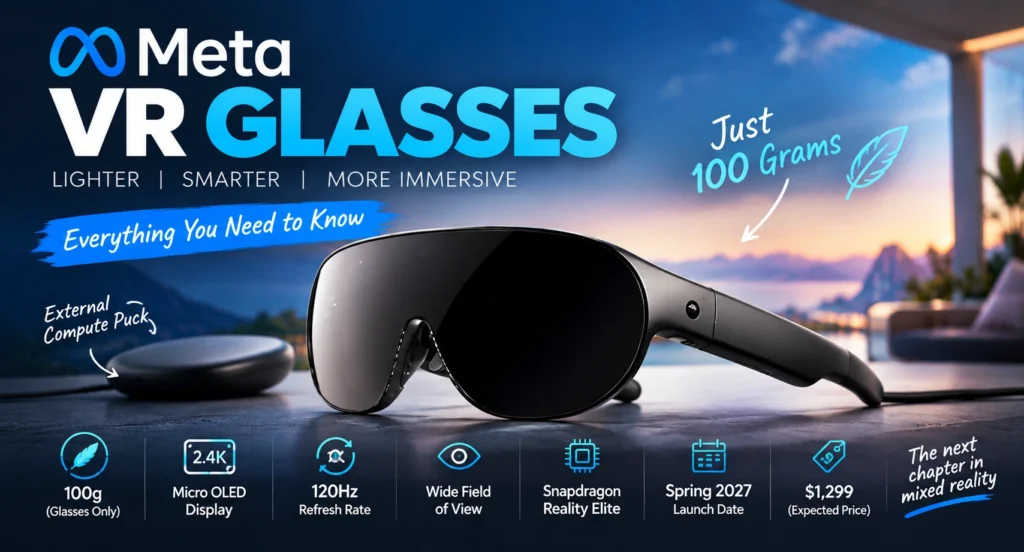
Meta just pulled back the curtain on its most radical VR product yet: the Meta VR Glasses 2.4K Micro-OLED headset. Announced at Meta Connect 2026, this device trades the bulky, self-contained Quest form factor for something closer to actual eyewear a 100-gram visor tethered to a compute puck, built around a pair of ultra-sharp 2.4K micro-OLED panels.
If you’ve been searching for what the Meta VR Glasses 2.4K micro-OLED display actually offers, how it stacks up against Quest 3 and Valve’s Steam Frame, or whether it’s worth waiting for, this guide covers everything currently known specs, pricing, software, and the trade-offs Meta made to get the weight this low.
What Is the Meta VR Glasses 2.4K Micro-OLED Headset?
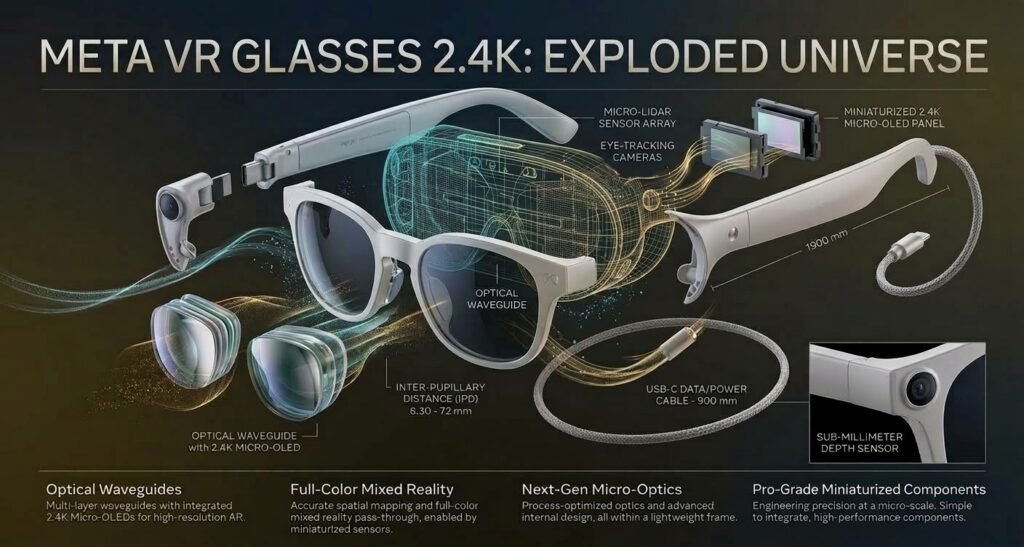
At its core, the Meta VR Glasses 2.4K micro-OLED device is a passthrough mixed reality visor priced at $1,300, set to ship in spring 2027. Unlike every Quest headset before it, this one has zero onboard computing not even a basic tracking chip. All processing happens in an external puck connected by a thin fiber-optic cable, which handles both power delivery and data transfer.
That puck runs the same software platform as Quest 3, meaning your existing Quest library carries over. The difference is horsepower: the puck is built around Qualcomm’s new Snapdragon Reality Elite chipset, a significant step up that renders Quest-style content at meaningfully higher fidelity, aided by eye-tracked foveated rendering.
Meta VR Glasses 2.4K Micro-OLED Display Specs Explained
The headline feature and the reason this product keeps coming up in searches for “Meta VR Glasses 2.4K micro OLED” is the display stack itself.
Resolution and Pixel Density
Each eye gets a 2412×2288 micro-OLED panel running at 120Hz, giving roughly 37 pixels per degree of angular resolution. That’s a substantial jump over Quest 3’s roughly 25 PPD, and it makes the Meta VR Glasses 2.4K micro-OLED panels the sharpest Meta has ever shipped in a consumer device. It’s also worth noting this marks Meta’s first non-LCD headset since the very first Oculus Quest, a meaningful architectural shift for the company.
Field of View Trade-offs
Here’s the catch that every buyer needs to understand before getting excited about the resolution numbers: the field of view is noticeably narrower than a traditional Quest headset. Meta lists 70° horizontal by 66° vertical (87° diagonal), compared to Quest 3’s roughly 110° by 96°. In practice, this means the Meta VR Glasses 2.4K micro-OLED headset will feel less immersive than Quest 3 in fully enclosed VR mode but that narrower FOV is part of the design trade-off that makes the glasses form factor and weight possible in the first place.
Refresh Rate and Panel Type
Both panels run at 120Hz, keeping motion smooth for gaming and video, while the micro-OLED panel type delivers deeper blacks and better contrast than the LCD panels found in Quest 3 and Steam Frame. Combined with color passthrough rated around 26 PPD, this is arguably the most visually refined mixed reality display Meta has produced.
Inside the Puck: Snapdragon Reality Elite Chipset
Performance Compared to Quest 3
The Snapdragon Reality Elite chip powering the compute puck is essentially a rebranded, more powerful evolution of the XR2 Gen 3 platform. Because all rendering happens externally rather than on a headset-mounted chip, the puck can push more graphical horsepower without adding heat or weight to the visor itself a major reason the Meta VR Glasses 2.4K micro-OLED unit can stay fanless and passively cooled.
RAM and Local Storage
The puck ships with 12GB of RAM, ahead of Quest 3’s 8GB, and includes 128GB of base storage with a microSD slot for expansion a feature notably absent from Quest 3.
Design and Comfort: Why Meta Calls Them “Glasses,” Not a Headset
Open-Periphery Passthrough
Rather than fully sealing off your vision like a traditional headset, the visor uses an open-periphery design, letting you naturally see your surroundings to the sides and below. This design choice reinforces why Meta is marketing this as “glasses” rather than a headset it’s built for short, casual, everyday sessions rather than marathon immersive gaming.
Weight and Materials
A magnesium alloy frame keeps total weight around 100 grams, a fraction of what Quest 3 weighs on your face. That lightness is only possible because there’s no onboard chipset, battery, or active cooling fan everything heavy lives in the tethered puck instead.
Meta VR Glasses 2.4K Micro-OLED vs Quest 3 vs Steam Frame
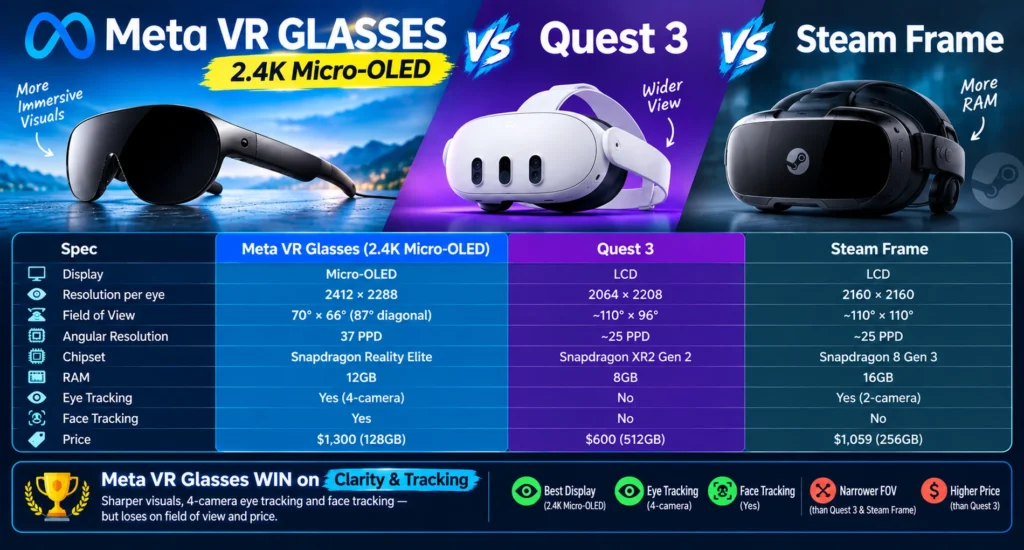
| Spec | Meta VR Glasses (2.4K Micro-OLED) | Quest 3 | Steam Frame |
| Display | Micro-OLED | LCD | LCD |
| Resolution per eye | 2412×2288 | 2064×2208 | 2160×2160 |
| Field of View | 70°×66° (87° diagonal) | ~110°×96° | ~110°×110° |
| Angular Resolution | 37 PPD | ~25 PPD | ~25 PPD |
| Chipset | Snapdragon Reality Elite | Snapdragon XR2 Gen 2 | Snapdragon 8 Gen 3 |
| RAM | 12GB | 8GB | 16GB |
| Eye Tracking | Yes (4-camera) | No | Yes (2-camera) |
| Face Tracking | Yes | No | No |
| Price | $1,300 (128GB) | $600 (512GB) | $1,059 (256GB) |
This comparison makes the positioning clear: the Meta VR Glasses 2.4K micro-OLED model wins decisively on visual sharpness, eye tracking, and face tracking, but loses on field of view and price against both competitors.
Controllers, Tracking, and Input Options
Touch Plus Controllers
Unlike Quest 3, controllers aren’t bundled by default. You can buy Touch Plus controllers separately, reuse controllers from an existing Quest 3 or Quest 3S, or wait for a bundled retail package that includes them in select channels.
Hand and Eye Tracking
Four onboard cameras enable eye tracking, which powers the foveated rendering that helps offset the demands of driving 2.4K micro-OLED panels at 120Hz. Hand tracking is also built in, supporting controller-free interaction across a growing library of titles.
Software Features: Hologram, Avatars, and New Games
Hologram Avatar System Explained
The Meta VR Glasses launch introduces Hologram, Meta’s productized version of its Codec Avatars research. It lets users join flatscreen WhatsApp video calls as a photorealistic, face-tracked avatar conceptually similar to Apple Vision Pro’s Persona feature. At launch, Hologram is limited to a “2.5D” front-facing stereoscopic stream rather than a full 3D volumetric presence, though Meta has stated it plans to evolve this into a true 6DoF avatar system that eventually replaces its cartoon-style Meta Avatars platform-wide.
New Games Including a Hand-Tracked Beat Saber Mode
Meta also revealed a slate of new hand-tracking titles for the platform, including “Flux,” a hand-tracked Beat Saber mode designed to take advantage of the headset’s tracking capabilities without requiring controllers.
Price, Release Date, and Availability
Cost Breakdown
The Meta VR Glasses 2.4K micro-OLED headset launches at $1,300 for the 128GB configuration more than double the price of Quest 3 and above Steam Frame’s $1,059 asking price.
Shipping Timeline
Meta has confirmed a spring 2027 shipping window, giving the company several months to refine software and expand the game library before units reach customers.
Should You Buy the Meta VR Glasses 2.4K Micro-OLED Headset?
If display sharpness, eye tracking, and a lightweight, glasses-like form factor matter most to you, this device delivers a meaningfully upgraded visual experience over Quest 3. But if wide field of view and full immersion are priorities especially for room-scale gaming the narrower FOV may feel like a step backward despite the resolution gains. This is shaping up to be a premium, media-and-productivity-focused device first, and a traditional VR gaming headset second.
Frequently Asked Questions
What does “2.4K micro-OLED” mean for the Meta VR Glasses?
It refers to the display resolution class of the dual micro-OLED panels used in the headset each running at 2412×2288 pixels delivering sharper text and imagery than the LCD panels found in Quest 3.
How much do the Meta VR Glasses 2.4K micro-OLED cost?
They’re priced at $1,300 for the 128GB storage configuration, set to ship in spring 2027.
Do the Meta VR Glasses come with controllers?
Not by default. Touch Plus controllers are sold separately, though existing Quest 3 or Quest 3S controllers can pair with the device, and a controller bundle will be available through select retailers.
How does the field of view compare to Quest 3?
It’s narrower 70° horizontal by 66° vertical (87° diagonal) versus Quest 3’s roughly 110° by 96° a trade-off Meta made to achieve the lightweight, glasses-style design.
What chipset powers the Meta VR Glasses?
A tethered puck contains Qualcomm’s Snapdragon Reality Elite chipset, an upgraded successor to the XR2 Gen 3 platform, paired with 12GB of RAM.
Does it support Quest 3 games and apps?
Yes. The puck runs the same operating system as Quest 3 and supports the same content library, rendered at a higher resolution.
What is Hologram on Meta VR Glasses?
Hologram is Meta’s new photorealistic avatar system, letting users appear as a face-tracked digital likeness on flatscreen WhatsApp calls, with plans to expand it into a full 3D avatar platform over time.
When do the Meta VR Glasses 2.4K micro-OLED headset ship?
Meta has set a spring 2027 release window following the Connect 2026 announcement.