Conversational AI: Revolutionizing Communication (5 Powerful Ways)
Conversational AI explained simply. Learn how it works, real examples, benefits, risks, and how to start, with clear answers to common questions. Have you ever typed a question into a…
Conversational AI explained simply. Learn how it works, real examples, benefits, risks, and how to start, with clear answers to common questions.
Have you ever typed a question into a website chat box and got a helpful answer in seconds? Or asked your phone to set an alarm just by talking? That’s conversational AI at work.
In this guide, you’ll learn what conversational AI is, how it works behind the scenes, where people use it, and what its limits are. No technical background needed. If you can follow a group chat, you can follow this.
What Is Conversational AI?
Conversational AI is technology that lets computers talk with people in normal human language, through text or voice. Instead of clicking buttons or filling forms, you just say or type what you want, and the system replies.
Think of it like a very fast, very patient helper that has read an enormous amount of text and learned how people usually ask for things.
Conversational AI in Simple Words
Imagine you ask a friend, “What time does the movie start?” Your friend knows you mean the movie you were talking about earlier. Good conversational AI tries to do the same thing. It understands your words, figures out what you want, remembers the context, and answers in a way that makes sense.
Conversational AI vs. a Regular Computer Program
A normal program only understands exact commands. Type the wrong word and it breaks. Conversational AI can handle messy, real-life language like “hey, my order never came” or “where’s my stuff??” and still understand you.
How Does Conversational AI Work?
Conversational AI works in a few steps, and it all happens in a second or two. Four main ideas make it possible.
Natural Language Processing (NLP)
NLP is the part that helps a computer deal with human language. It breaks your sentence into pieces and works out the meaning. It has two jobs:
- Understanding what you wrote or said (called natural language understanding, or NLU)
- Writing a reply that sounds natural (called natural language generation, or NLG)
Machine Learning (ML)
Machine learning is how the system gets smarter. Instead of programmers writing every rule, the system studies huge numbers of example conversations and finds patterns. The more good examples it learns from, the better its answers get.
Speech Recognition and Text-to-Speech
If you talk to a voice assistant, two extra tools join in. Speech recognition turns your voice into text. Text-to-speech turns the reply back into a spoken voice.
Large Language Models and Generative AI
Modern conversational AI often uses large language models (LLMs). These are very large AI systems trained on massive amounts of text. They can write fresh answers instead of just picking from a list of prewritten ones. This is why newer conversational AI feels far more natural than older chatbots.
The Step-by-Step Journey of One Message
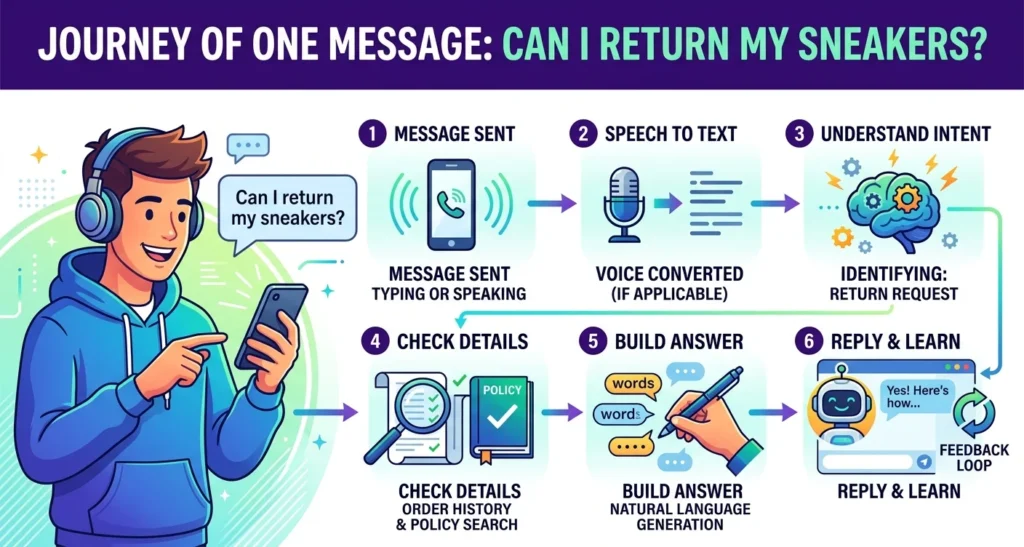
Here’s what happens when you ask, “Can I return my sneakers?”
- You send the message by typing or speaking.
- The system converts speech to text (only for voice).
- The system works out your intent. Here, you want a return.
- It checks for details, like your order and the return policy.
- It builds an answer in natural language.
- It replies and learns from how the chat went.
Types of Conversational AI
Not all conversational AI is the same. The label covers several different tools.
Rule-Based Chatbots
These follow a script, like a flowchart. If you click “Track order,” they show the tracking step. They’re simple and cheap, but they get stuck when you ask something unexpected.
AI-Powered Chatbots
These use NLP and machine learning, so they understand many ways of asking the same question. They handle surprises much better than rule-based bots.
Voice Assistants
Siri, Alexa, and Google Assistant are voice-based C-AI. They live in phones, speakers, and cars.
AI Agents
This is the newest type. An AI agent doesn’t only talk. It can take action, like booking an appointment, processing a refund, or updating an account.
Quick Comparison
| Type | How smart is it? | Best for |
| Rule-based chatbot | Basic, follows a script | Simple FAQs |
| AI chatbot | Understands varied wording | Customer support |
| Voice assistant | Understands speech | Hands-free tasks |
| AI agent | Understands and acts | Complex, multi-step jobs |
Where Is Conversational AI Used?
You probably use C-AI more than you realize.
Customer Support
Online stores and banks use C-AI to answer questions any time of day, such as order status, passwords, and refunds.
Education
Learning apps use it as a study buddy. It can explain a topic, quiz you, or help you practice a new language. A student can ask the same question five different ways without the helper getting annoyed.
Healthcare
Clinics use C-AI to book appointments, send reminders, and answer simple administrative questions. It should never replace a real doctor for medical advice.
Shopping
A shopping assistant can suggest products, answer sizing questions, and guide you to checkout, much like a helpful store worker.
Workplaces
Companies use C-AI for HR questions (such as “How many vacation days do I have?”) and IT help (such as “My laptop won’t connect to Wi-Fi”).
Accessibility
Voice tools and text-to-speech help people who have trouble typing, reading, or seeing a screen. Instant translation also helps people talk across languages.
Benefits of Conversational AI
It Works 24/7
Humans need sleep. AI doesn’t. Customers get help at 3 a.m. just as fast as at 3 p.m.
It Saves Money and Time
Handling common, repetitive questions automatically frees human staff for harder problems.
It Scales Easily
During a big sale or holiday rush, thousands of people can chat with a AI system at the same moment. Hiring and training thousands of workers that fast is not realistic.
It Gives Consistent Answers
People have good and bad days. A well-built system gives the same accurate policy information every time.
It Can Personalize Help
When connected to the right data, AI can greet you by name, remember your past orders, and suggest things you might actually like.
Limits and Risks of Conversational AI
Most guides skip this part, but it matters. Conversational AI is impressive, and it is not perfect.
It Can Be Wrong
Systems built on large language models can sometimes give answers that sound confident but are incorrect. Experts call this “hallucination.” Important answers should be double-checked.
It Struggles With Human Quirks
Heavy accents, slang, background noise, sarcasm, and mixed emotions can confuse it. If you say “Great, another delay, thanks a lot,” a person hears frustration. A weak system may hear “great” and “thanks.”
Privacy and Security Matter
Conversational AI often handles personal information. Companies must protect it. As a user, avoid sharing passwords, ID numbers, or bank details in a chat unless you’re sure it’s secure.
People Want a Human Option
Some problems are emotional or complicated. Good systems let you reach a real person easily. Being forced to argue with a bot is one of the most frustrating experiences in customer service.
Honesty Builds Trust
A good company tells you when you’re talking to AI. Being open about it makes people trust the experience more.
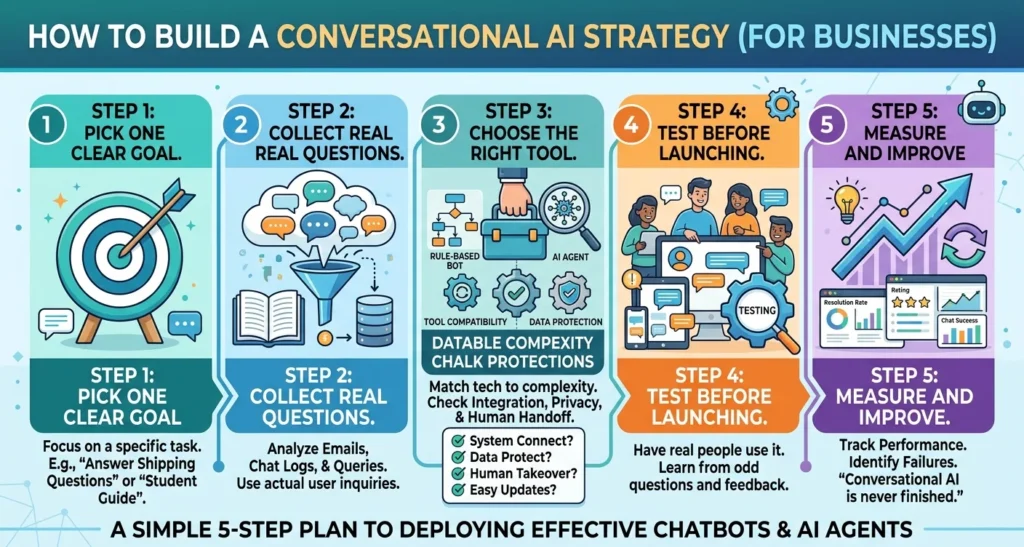
How to Build a Conversational AI Strategy (For Businesses)
If you run a business or a school project and want to try conversational AI, here’s a simple plan.
Step 1: Pick One Clear Goal
Don’t try to do everything. Choose one job, like “answer shipping questions” or “help new students find the library.”
Step 2: Collect Real Questions
Look at emails, chat logs, and search queries. The questions people actually ask matter more than the ones you imagine.
Step 3: Choose the Right Tool
Match the tool to the job. A simple rule-based bot may be enough for basic FAQs. Complex tasks may need an AI agent.
What to Check Before You Choose
- Can it connect to your existing systems?
- Does it protect customer data?
- Can a human take over smoothly?
- Can non-programmers update it?
Step 4: Test Before Launching
Have real people try to break it. Their odd questions will show you the gaps.
Step 5: Measure and Improve
Track how often it solves problems, how people rate it, and where chats fail. Then improve it, over and over. Good conversational AI is never “finished.”
Common Mistakes to Avoid
- Launching without a human backup. Always give people a way out.
- Making it pretend to be human. It confuses people and damages trust.
- Feeding it outdated information. Wrong answers spread fast.
- Ignoring feedback. Chat logs are a goldmine of improvements.
- Expecting perfection on day one. It improves with time and data.
The Future of Conversational AI
Conversational AI is moving from “answering questions” toward “getting things done.” Expect more voice-first tools, support in more languages, assistants that remember your preferences, and AI agents that can handle multi-step tasks on their own. Strong rules around privacy, safety, and honesty will matter just as much as the technology.
Frequently Asked Questions About Conversational AI (FAQs)
What is conversational AI in simple words?
Conversational AI is technology that lets you talk to a computer the way you’d talk to a person, by typing or speaking. It understands what you mean and replies in natural language.
What is the difference between a chatbot and conversational AI?
Conversational AI is the broader category. A chatbot is one type of it. Some chatbots only follow fixed scripts, while true conversational AI can understand varied language and learn over time.
What is the difference between conversational AI and generative AI?
Conversational AI is built for back-and-forth dialogue. Generative AI creates new content like text, images, or music. Many modern conversational AI tools use generative AI so their replies sound more natural.
How does conversational AI learn?
It studies large amounts of text and speech examples, finds patterns in how people communicate, and improves with feedback and new data over time.
What are some examples of conversational AI?
Common examples include website support chatbots, voice assistants like Siri, Alexa, and Google Assistant, AI study helpers, and virtual agents that book appointments or answer HR questions.
Is conversational AI safe to use?
It can be safe when built and used responsibly. Use trusted services, avoid sharing sensitive details unnecessarily, and double-check important information, since AI can make mistakes.
Will conversational AI replace human workers?
It will change many jobs, mostly by taking over repetitive tasks. Humans are still needed for complex, emotional, and creative work, and for supervising the AI itself.
Can conversational AI understand different languages?
Many systems can understand and reply in multiple languages. Quality varies by language, and common languages usually work best.
How much does conversational AI cost?
It depends on the tool. Simple bots can be low-cost or even free, while advanced enterprise platforms are priced by usage, features, and size. Check each provider’s current pricing.
What skills do I need to start with conversational AI?
Many modern platforms are no-code or low-code, so beginners can start with drag-and-drop tools. Learning basic ideas like intents, questions, and testing helps a lot.
Final Thoughts on Conversational AI
Conversational AI helps computers talk with people in a natural way. It powers the chat boxes, voice assistants, and AI helpers we use every day. It’s fast, available all the time, and increasingly capable. It also needs honesty, privacy protection, and human backup to work well. Whether you’re a student curious about the technology, a business owner exploring support tools, or a developer ready to build, understanding AI is a smart skill to have right now.