
NPCs That Remember Player Choices: 6 Brilliant Game-Changing Systems
NPCs that remember player choices are the real secret to making a game world feel alive. Nothing hits quite like an in-game character calling you out for a side quest…
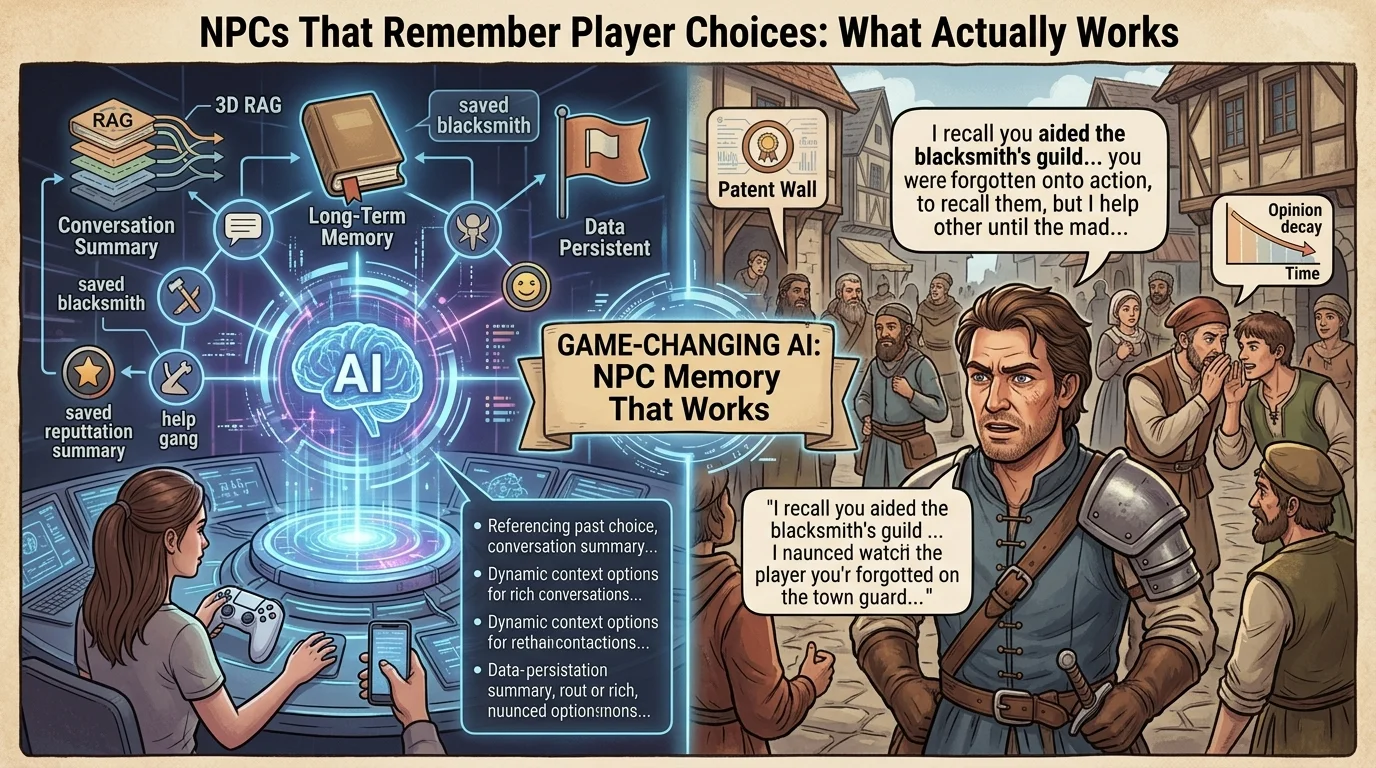
NPCs that remember player choices are the real secret to making a game world feel alive. Nothing hits quite like an in-game character calling you out for a side quest decision you made three weeks ago in a totally different city. It’s easily the most talked-about feature in gaming today, yet it’s also the single hardest trick for developers to pull off convincingly.
This isn’t a theory piece. Below is how memory actually gets built in shipped games, what the current tech stack looks like, where it breaks, and how to fake it convincingly if you don’t have an AI budget.
What “NPC Memory” Actually Means (And What It Doesn’t)
Let’s kill the vagueness up front. An NPC “remembering” you is just a stored value being checked later a save-persistent record of something you did, referenced in future dialogue or behavior. That’s the entire mechanism. What varies wildly is how much gets stored and how naturally it resurfaces.
The clearest way to separate the real thing from the illusion: does the memory survive a save and reload, weeks later, in a different context? If yes, you’re looking at genuine long-term memory. If the NPC (NPCs that remember player choices) only “remembers” something for the current combat encounter or conversation, that’s short-term state useful, but not what players mean when they praise this feature.
The Three Real Approaches Studios Use
Flag and Reputation Systems
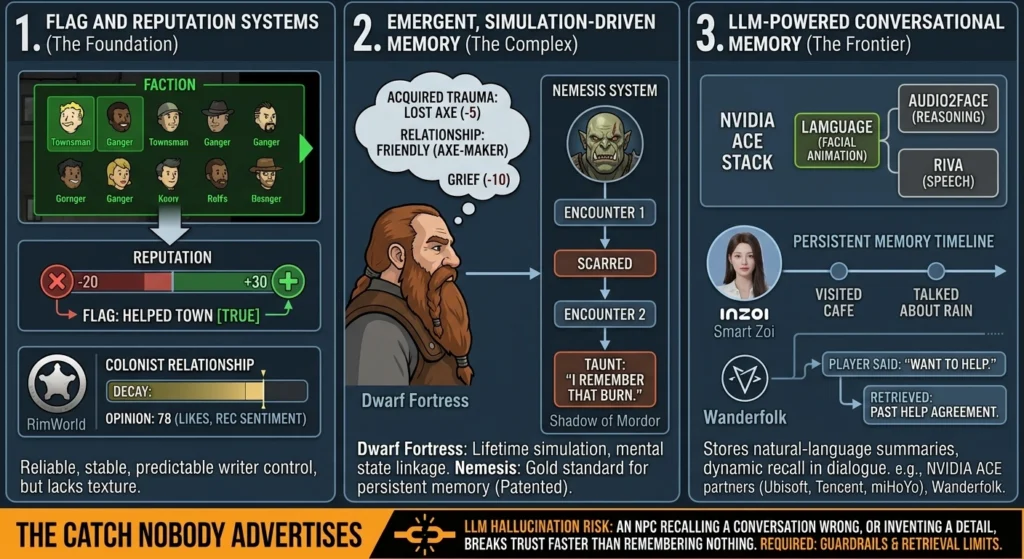
This is the oldest and still most common method and it’s not obsolete, it’s just unglamorous. Fallout: New Vegas tracks reputation across its Mojave factions, so the same early decision (help the town, help the gang, walk away) ripples into how (NPCs that remember player choices) across the map treat you for the rest of the game. RimWorld goes further at a smaller scale: colonists form individual opinions of each other based on observed interactions, and those opinions decay naturally over time rather than sitting frozen.
The advantage here is stability no hallucinations, no runaway costs, predictable writer control. The tradeoff is granularity: the game remembers that something happened and adjusts a number, not the texture of how it happened.
Emergent, Simulation-Driven Memory
Dwarf Fortress takes this further than almost anything else on the market individual dwarves accumulate grief, trauma, and relationships across an entire simulated lifetime, with memory feeding directly into mental state rather than sitting in a separate “quest flag” layer.
The best-known example of this done at AAA scale is the Nemesis System from Middle-earth: Shadow of Mordor and Shadow of War orc captains remember specific encounters with the player, return scarred or promoted depending on what happened, and taunt you about fights you may have forgotten. It’s still the gold standard for player-remembered NPCs that remember player choices memory a decade later, and there’s a structural reason nobody’s replicated it exactly: Warner Bros. holds the patent on the mechanic until 2036, which has kept it a one-franchise feature rather than an industry standard.
LLM-Powered Conversational Memory
This is the newest layer, and it’s the one changing fastest. Instead of flags or numeric scores, the NPC stores natural-language summaries of what you actually said and did, then retrieves relevant ones dynamically when generating new dialogue.
NVIDIA’s ACE (Avatar Cloud Engine) is the infrastructure most studios are building on for this a stack combining a language model for reasoning, Audio2Face for real-time facial animation, and Riva for speech, with partners including Ubisoft, Tencent, NetEase, and miHoYo integrating pieces of it. inZOI’s “Smart Zoi” system runs on this kind of architecture, giving life-sim characters stated goals and reactive personalities shaped by accumulated experience rather than a fixed script.
The clearest example of memory as the entire game design, not a bolted-on feature, is Wanderfolk a village-survival RPG where villagers hold persistent, vector-based memory of your conversations across sessions, track reputation on a –100 to +100 scale, and spread opinions of you through a gossip network between NPCs. Reputation isn’t cosmetic there it gates jobs, shop prices, and can end the run entirely if it collapses far enough.
The Catch Nobody Advertises
LLM-driven memory has a real cost most marketing pages skip: hallucination. An NPC recalling a conversation wrong, or inventing a detail that never happened, breaks trust faster than an NPC that remembers nothing at all. Every studio shipping this tech right now is layering guardrails and retrieval limits specifically to keep memories from drifting away from what actually happened.
Why This Feature Actually Moves the Needle
Industry-wide, this isn’t a fringe experiment anymore. A Boston Consulting Group analysis found that roughly half of game studios were actively using AI tools in production by early 2026, and about one in five new Steam releases disclosed AI integration in their character systems. Persistence memory that connects past player behavior to present NPC (NPCs that remember player choices) behavior is what analysts have started calling the “memory-first” design paradigm now dominant in AI-driven NPCs that remember player choices work.
The psychological reason is simple: being remembered is a basic social signal of mattering. A world that reflects your history back at you turns passive play through into something closer to a relationship. And the inverse is just as strong nothing collapses immersion faster than an NPC referencing one choice while ignoring three others that should logically matter just as much. Inconsistent memory reads as a bug, not a feature.
How to Fake It Convincingly Without an AI Budget
Most teams don’t need Nemesis-level or Wanderfolk-level infrastructure to get 80% of the emotional payoff. Three techniques do most of the work:
- Anchor a handful of high-weight choices, not everything. Pick the three or four decisions with real narrative stakes and track those properly. Trying to remember every minor interaction is how memory systems balloon and slow down.
- Let small callbacks do the heavy lifting. An NPC referencing a detail from one earlier conversation reads as more “alive” than an elaborate branching questline players fill in the emotional gap themselves once they sense the world noticed.
- Never contradict established personality. Consistency is the cheapest memory system that exists. An NPC with a fixed stance and a recurring verbal habit feels remembered even when nothing is technically being stored.
Building It Technically: A Short Checklist
- Decide which choices actually deserve tracking not every action needs a flag.
- Pick your model: flags for small scope, reputation scores (RimWorld/New Vegas-style) for faction-driven games, vector/LLM memory (Wanderfolk/ACE-style) for conversation-heavy projects.
- Make storage save-persistent, not session-only.
- Add decay or importance-weighting so trivial memories fade before major ones do.
- Add guardrails if using generative memory hallucinated recall is worse than no recall.
- Playtest specifically for contradiction: does any NPC ever reference something that didn’t happen, or forget something that clearly should still matter?
FAQ: NPCs That Remember Player Choices
Do NPCs need Artificial Intelligence to remember player choices?
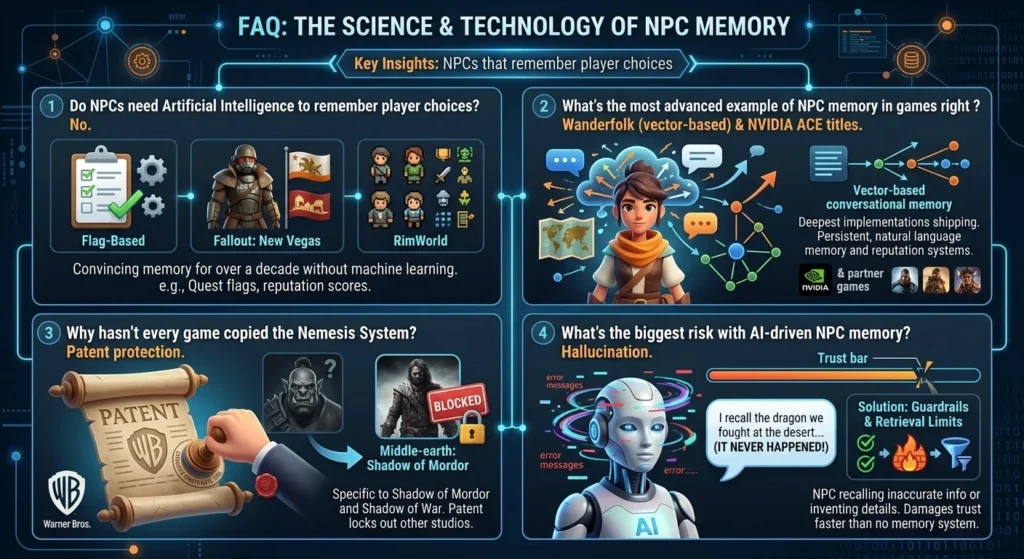
No. Flag-based and reputation systems the approach behind Fallout: New Vegas and RimWorld have delivered convincing memory for over a decade without any machine learning involved.
What’s the most advanced example of NPC memory in games right now?
Wanderfolk’s vector-based conversational memory paired with a gossip-propagating reputation system is currently one of the deepest implementations shipping, alongside NVIDIA ACE-powered titles using similar infrastructure.
Why hasn’t every game copied the Nemesis System?
Because it’s patented. Warner Bros. Interactive Entertainment holds exclusive rights to the mechanic until 2036, which is the main reason it remains specific to the Shadow of Mordor and Shadow of War games.
What’s the biggest risk with AI-driven NPC memory?
Hallucination, an NPC recalling something inaccurately or inventing a detail. It damages trust faster than having no memory system at all, which is why guardrails and retrieval limits matter as much as the memory model itself.